Refactoring RPLidar Driver (Final): The Birth of the 'Zombie Node' & v1.0.0 Release
Code that compiles isn't enough. We tackle runtime reconfiguration, the Zero-Copy trap, and USB hot-plug recovery to build a driver that refuses to die.
Intro: The Gap Between “Compilable” and “Production-Ready”
In Part 3, we discussed how to tame hardware fragmentation using the Factory Pattern and handled timing constraints with a Finite State Machine (FSM). We successfully abstracted the messy reality of A-Series vs. S-Series protocols.
The code structure is now clean. But does a “logically perfect” code guarantee a robust robot in the field?
In an operational environment, chaos is the norm:
- What if we need to change the scan rate (RPM) mid-operation?
- What if a user accidentally kicks the USB cable loose?
- What if the USB permission (
chmod) is reset after a reboot?
In this final part of the series, we tackle these Operational Level challenges. We will finalize the “Zombie Node”—a driver that refuses to die—and officially release v1.0.0.
1. Functional Completion: Runtime Dynamic Reconfigure
One of the biggest pain points with the legacy driver was the need to restart the entire node just to change a parameter. Restarting a process just to switch from “Indoor Mode (Low RPM)” to “Outdoor Mode (High RPM)” is inefficient and disrupts the robot’s autonomy.
To solve this, I implemented the ROS 2 Parameter Callback to enable true runtime control.
Thread Safety and The Mutex
The critical challenge here is Thread Safety. If the main thread changes the configuration while the polling thread is reading from the serial port, it leads to data corruption or a Segmentation Fault.
To prevent this, I introduced a std::mutex in the wrapper layer. The reconfiguration sequence—[Stop Motor -> Update Config -> Start Motor]—is executed atomically under a lock.
// Example: Thread-Safe Parameter Callback
rcl_interfaces::msg::SetParametersResult parameters_callback(...) {
    // Lock the driver to prevent data race with the polling thread
    std::lock_guard<std::mutex> lock(driver_mutex_);

    if (param.name == "rpm") {
        driver_->set_motor_speed(new_rpm); // Apply immediately
    }
    else if (param.name == "scan_mode") {
        driver_->stop_motor(); // Stop scanning
        driver_->start_motor(new_mode); // Restart with new mode
    }
    return result;
}
Now, you can dynamically adjust the LiDAR’s behavior using ros2 param set without killing the node.
(Note: Complex data post-processing, such as Angle Compensation, is encapsulated within the SDK Wrapper, allowing the upper-level node to focus solely on physical constraints.)
2. The Optimization Trap: The Illusion of Zero-Copy
Early in the refactoring process, I aimed to implement Zero-Copy (Loaned Messages), often cited as the “Holy Grail” of ROS 2 performance. Spoiler Alert: I abandoned it.
Why loaned_message Failed
The core data fields of sensor_msgs::msg::LaserScan—ranges and intensities—are std::vector types (dynamic arrays).
For Zero-Copy to work, the middleware (RMW/DDS) needs to pre-allocate a shared memory segment of a fixed size. However, since the LiDAR’s point count can vary, the middleware rejects the loan request.
[rclcpp]: Currently used middleware can't loan messages. Local allocator will be used.
(This log message, which flooded my terminal, was the smoking gun.)
The Pragmatic Compromise: std::move
There is no Silver Bullet. Instead of forcing an incompatible optimization, I pivoted to C++ Move Semantics (std::move) and std::unique_ptr. This eliminates unnecessary deep copies during the publish process. For LiDAR data (typically a few KBs), this approach is more than performant enough.
3. Verification: The Driver That Refuses to Die
The ultimate goal of this project was Robustness. Legacy drivers would crash (exit(1)) upon any exception. The refactored driver, powered by LifecycleNode and FSM, is designed to recover.
Test 1. Permission Denied
If the node is launched without proper permissions (chmod), the legacy driver would either output garbage data or crash.
My driver now catches this exception, transitions to an ERROR state, and broadcasts a clear diagnostic message, waiting for the user to grant permissions.
Test 2. Hot-Plug Recovery (The Ultimate Stress Test)
I physically unplugged the USB cable while the scanner was running at full speed.
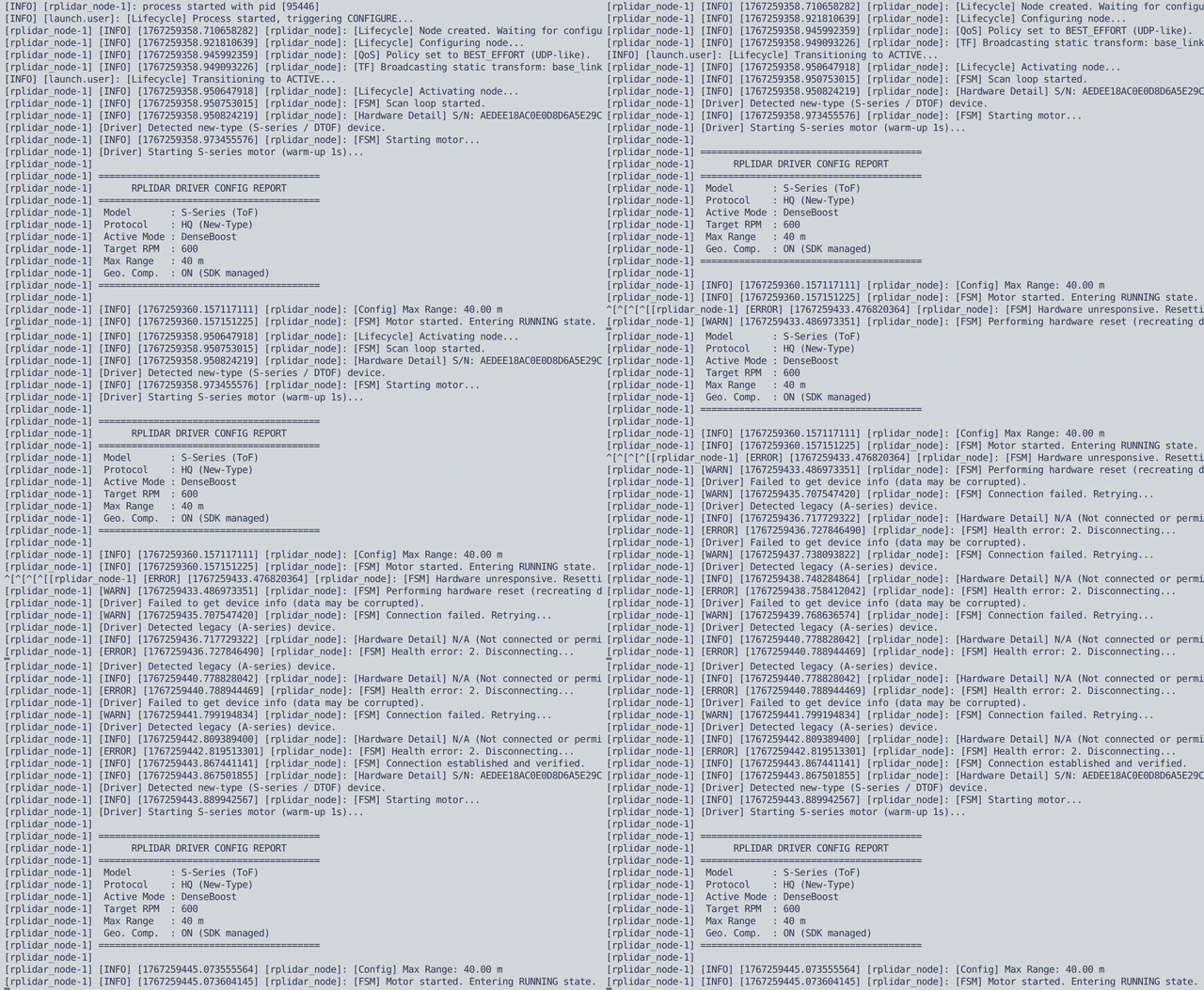 (Caption: The node transitions to Error handling upon disconnection and immediately resumes scanning once the cable is reconnected.)
There is no need for systemd to restart the service. The node monitors the hardware health and recovers itself.
4. Conclusion: v1.0.0 Release
After stripping away the legacy Slamtec code and rewriting the core logic with Modern C++ and ROS 2 Lifecycle principles, I am proud to release v1.0.0.
This project aimed to go beyond “code that works” to create “code that survives in production.” I have primarily validated this on the RPLidar S3. If you own legacy models (A1, A2), I welcome your test reports.
Key Features
✅ Lifecycle Managed: Strict state management (
Unconfigured->Active).✅ Fault Tolerant: Supports USB hot-plugging and auto-recovery.
✅ Thread-Safe: Supports runtime parameter updates without crashes.
You can find the source code and installation instructions in the repository below.